India a proving ground for personalisation at scale: SAS CMO Jennifer Chase
At Cannes Lions 2026, SAS CMO Jennifer Chase says AI's biggest impact will come from better decisions, not just content creation
 by
by
Published: Jun 25, 2026 2:30 PM | 8 min read
 Follow Us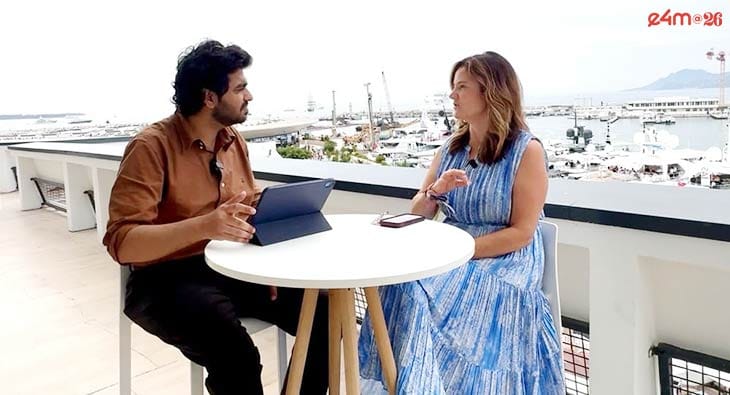

- Jennifer Chase described her experience at Cannes Lions as inspiring, emphasizing the potential of marketing to drive business growth and the importance of decision-making over AI-generated content in the future of marketing.
- Chase highlighted the challenge marketers face with abundant customer data and martech tools, stressing the need for better integration and understanding of customer signals to avoid negative personalization experiences.
- She called for a shift in the marketing conversation towards the human purpose of technology, advocating for responsible AI implementation and prioritizing privacy over personalization.
- Chase pointed out the significance of digital twins as an emerging technology for understanding customer behavior and emphasized SAS's commitment to helping clients realize the true impact of AI beyond the hype.
This interview was originally published on MartechAI.com
Speaking to Brij Pahwa for MartechAI, and exchange4media, Jennifer Chase said Cannes Lions had been “an incredible trip,” filled with inspiration and energy around the role marketing can play in helping businesses grow. Cannes Lions 2026 is taking place in Cannes, France, from June 22 to 26, 2026.
Asked whether AI-generated content or AI-generated decisions would have a bigger impact on marketing in the next few years, Chase was clear.
“Absolutely decisions,” she said.
She said the marketing community has spent the last two years grappling with what it means to be a marketer in the era of generative AI. But according to Chase, basic generative AI tools may improve productivity, without necessarily becoming the force that drives truly meaningful customer experiences.
“The basic generative AI tools are probably going to elevate our productivity, but they’re not going to be what drives true customer experience,” she said, adding that the bigger opportunity lies in making the right decisions in the moment of customer interaction.
For Chase, the future of AI in marketing is not about removing human judgment. It is about strengthening it.
“That’s an area where it’s going to take both humans and AI. And actually, people need to be leading that,” she said. “AI is there to help you make better decisions, but you ultimately own those decisions.”
The discussion also turned to one of marketing’s most persistent contradictions: brands have more customer data and more martech tools than ever before, yet many still struggle with poor targeting, over-personalisation and disconnected customer experiences.
Chase said the issue is not a lack of signals. Marketers now have more signals of consumer interest and behaviour than they have ever had. The problem is whether brands have actually harnessed those signals across the organisation.
“Something that we see is a lot of marketers have first-party data scattered throughout their organization,” she said.
She pointed out that if a customer has contacted a support centre or interacted with a company through another channel, brands need to bring those signals together to show that they truly understand the customer’s need. Without that, AI can make the problem worse.
“One of the things I fear is some generative AI can actually make us faster to scale bad personalization,” Chase said. “We have to be really careful that we don’t scale those negative personalization, negative experiences, just because we can scale fast.”
Chase also raised an important question around differentiation in the age of large language models. If every marketer has access to the same prompt, the same model and broadly similar capabilities, she said brands need to ask where their distinctiveness will come from.
“Technology is here in service of us,” she said. “One of the superpowers we have as marketers is to truly understand our consumer and then really align what is your brand’s distinctive capabilities to those consumer needs.”
The pressure on CMOs to prove the business impact of marketing is also intensifying. Chase said there has “never been so much pressure sitting in a CMO seat” as there is today. She said one mistake marketers often make is buying too many point solutions without thinking enough about how those tools work together as an ecosystem.
During the conversation, the scale of the martech market came up through Scott Brinker’s landscape. The 2026 Marketing Technology Landscape lists 15,505 martech products, up 0.79 percent from the previous year, effectively validating the “roughly 16,000 tools” pressure point discussed in the interview.
But Chase said the number of tools is not the main issue. What matters is whether they are working together across the customer journey.
“It’s not necessarily going to be how many tools that you have, but how do you have them working and orchestrating for you across what is the customer journey,” she said.
She also said marketers often struggle to prove value because of language. According to Chase, marketers can get caught up in their own vocabulary, focusing on activity rather than output and impact.
“We all need to understand the C-suite’s language of growth and really convey our impact to the business in their terms, not ours,” she said.
Asked what the real conversation around AI should be at platforms like Cannes Lions, Chase said the industry needs to return to the human purpose behind the technology.
“In the end, we are real people selling real products to real people,” she said. “So let’s get back down to the humanity of this all.”
She said the conversation should shift towards how AI can be implemented in a governed, trustworthy and responsible way, with a positive impact on all communities that engage with it.
On what a modern marketing stack should look like, Chase said brands need a listening layer that captures signals of customer behaviour, followed by a data layer, a deep analytical layer and then channel orchestration. The analytical layer, she said, should help understand channels and decide the best offer, time and channel for a customer.
At SAS, Chase said the company uses its own technologies for this, including SAS Viya and SAS Customer Intelligence 360. SAS describes Viya as its AI and analytics platform, while Customer Intelligence 360 is described as a cloud-based, AI-powered customer engagement platform that helps organisations unify customer data, orchestrate journeys and activate messages in real time across channels.
India also featured in the conversation. Chase said she regularly speaks with the SAS marketing team in India and described the country as a proving ground for personalisation at scale because of its scale, linguistic diversity and cultural fragmentation. India has 22 scheduled languages under the Eighth Schedule of the Constitution.
“India is a very important market to us, not only from our customer perspective, but from our employee perspective,” she said, adding that SAS has a large R&D office in Pune. SAS India’s official careers page says SAS R&D India was established in 2000 as a key offshore innovation hub and is located in Magarpatta City, Pune.
In a rapid-fire round, Chase called AI the most overrated marketing buzzword at the moment. She named ServiceNow as a brand doing impressive marketing, said marketers measure impressions too much and do not measure emotions enough, and chose “human intuition powered by the algorithm” over a simple choice between human intuition and algorithms.
On the debate between personalisation and privacy, Chase was direct.
“Privacy has to reign over personalization,” she said.
Asked about the most exciting technology of the next decade, she pointed to digital twins. She said SAS is already working with customers in manufacturing where physical environments can be replicated digitally to create “what-if” scenario grounds. Chase said marketers could begin using digital twins in retail settings to better understand customer behaviour.
“I think digital twins is what we’ll be talking about in Cannes in three years, three to five years,” she said.
Chase declined to choose between OpenAI and Anthropic, saying she wants to understand how all of them work and how SAS is discovered across them. Asked to choose between Sam Altman and Elon Musk, she instead pointed to SAS CEO Dr. Jim Goodnight. SAS officially lists Goodnight as co-founder and CEO, and says he has led the company since its inception in 1976.
“What’s next for SAS?” Chase said the company is focused on helping customers get past the hype of AI and find real impact, particularly in high-stakes industries such as banking and life sciences.
“We are looking at how do we help our customers really get past the hype of AI and find that impact, that true impact,” she said.
For Chase personally, the mission is also about building greater awareness for SAS.
“I feel like we’re a brand that more people need to know,” she said. “It’s an honor for me to get to be this steward of our brand right now.”
Away from work, Chase said she has picked up golf as an adult. She joked that she is “horrible at it,” but still loves to play.
For marketers navigating the AI wave, Chase’s message was clear: the future of marketing will not be defined only by faster content creation. It will be defined by better decisions, stronger governance, responsible implementation and the ability to keep human judgment at the centre of AI-led transformation.
Read more news about Marketing News, Advertising News, PR and Corporate Communication News, Digital News, People Movement News
For more updates, be socially connected with us onInstagram, LinkedIn, Twitter, Facebook, YouTube & Google News